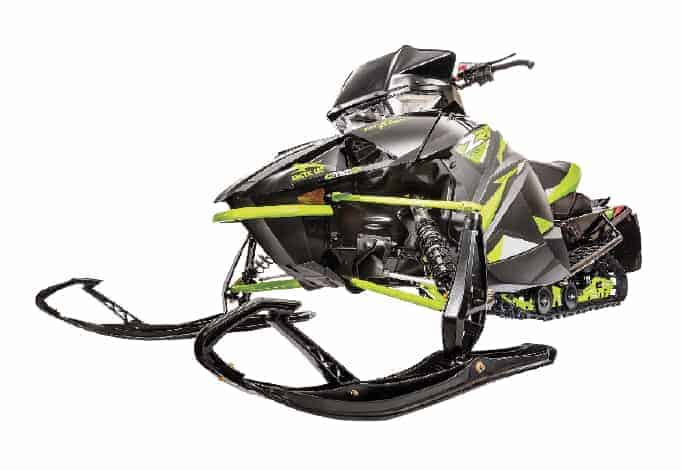
MX Z 500SS Electric Start

Dale Daudt of Jenkins, Minnesota says; “I am writing in response to John in Connecticut with the clutch engagement problem on his 2007 Ski-Doo MX Z 500SS with electric start (Dear Ralph ‘It Ain’t Right’ March 2008).
I have experienced the very same problem from 0-10 mph. I installed a TEAM primary spring, part number #210141-014. This spring has a rate of 160-380, so you could also use Ski-Doo part number 417 222 703 which should also be a 160-380 rate spring. Your problem will go away!”


No Oil Shortage

Don’t believe what you read and hear about the so-called shortage of oil. The good old USA has plenty of oil, and a huge amount of it is in North Dakota. Didn’t hear about that yet? You should be asking why not.
America is sitting on top of a super massive 200 billion barrel oil field that could potentially make America energy independent and, until now, has largely gone unnoticed. Thanks to new drilling technology, the “Bakken Formation” in North Dakota could boost America’s oil reserves by an incredible 10 times, giving western economies the trump card against OPEC’s short squeeze on oil supply and making Iranian and Venezuelan threats of disrupted supply irrelevant.
The USGS (U.S. Geological Survey) released a report in April giving an accurate resource assessment of the Bakken Oil Formation that covers North Dakota and portions of South Dakota and Montana. With new horizontal drilling technology it is believed that from 175 to 500 billion barrels of recoverable oil are held in this 200,000 square mile reserve that was initially discovered in 1951. The USGS did an initial study back in 1999 that estimated 400 billion recoverable barrels were present but with prices bottoming out at $10 a barrel back then the report was dismissed because of the higher cost of horizontal drilling techniques that would be needed, estimated at $20-$40 a barrel.
It was not until 2007, when EOG Resources of Texas started a frenzy when they drilled a single well in Parshal N.D. that is expected to yield 700,000 barrels of oil that real excitement and money started to flow in North Dakota. Marathon Oil is investing $1.5 billion and drilling 300 new wells in what is expected to be one of the greatest booms in oil discovery since oil was found in Saudi Arabia in 1938.
The United States imported about 14 million barrels of oil per day in 2007, which means U.S. consumers sent about $340 Billion Dollars over seas building palaces in Dubai and propping up unfriendly regimes around the World. If 200 billion barrels of oil at $90 a barrel are recovered in the high plains, the added wealth to the U.S. economy would be $18 Trillion Dollars! This would go a long way in stabilizing the U.S. trade deficit and could cut the cost of oil in half in the long run. Oil shortage? Not here!
Resource: Next Energy News


2007 IQ Oil Consumption

SnowTech Technical Consultant Randy Sturm alerted us that Polaris had issued a service bulletin in regards to the subject of excessive oil consumption on 2007 IQ 600 CFI models, like we had discussed in the “Dear Ralph” section of our April 2007 issue. If you have a 2007 Polaris IQ 600 CFI and it barely uses any injection oil, refer to your local dealer for the proper procedure to verify proper oil pump calibration and to maintain reliable performance.


Monoshock Set-Up Charts

In the March 2007 issue on Page 10 in the “Feedback” section in a blurp titled “Monoshock Set-up” we referred to some Charts from the Yamaha Snowmobile Technical Update manual – Here they are in JPG format along with the write up from the March issue:

Dear SnowTech:
In a recent issue you ran an article in the service and tuning notes section concerning the Yamaha Monoshock suspension setup. In the article you stated Yamaha dealers would be able to provide a matrix chart that graphically shows all of the weight ranges and settings for the Monoshock suspension. I contacted two local Yamaha dealers and they told me they had no idea what I was talking about. They informed me that the only chart available was the one in my owners manual, however, that chart only tells hard/medium/soft settings; not how to set up the set in for my weight and riding style. I purchased an 2007 Attack GT and am wondering if you could print this matrix chart since my local Yamaha dealers are either incompetent, or lazy, and unable to provide me with this chart.
Wayne Gerhartz

Here are those charts since so many of you have told us your dealers don’t know what we’re talking about. Tell them it’s in their Yamaha Snowmobile Technical Update manual, every dealer has one. For 2006 models, refer to the 2006 version, and for 2007 models refer to the 2007 version. Yamaha provides this info to their dealers, but it clearly isn’t getting through to the owners. Here are the 2007 model Graphs:


Boyesen Reeds in Rotax Series III

SnowTech reader Greg Ankofski provided valuable information in regards to installing a set of Boyesen reeds into a Rotax Series III engine;

“Just got done reading (in the March issue) about the guy with the 2005 REV 600 using Boyesen reeds having the bogging problem. I know from first hand experience that Boyesens in that sled will need a RICHER pilot setup to account for the added air flow off of idle (compounded by reed spacers, if using them, which reduce the carb signal). The area where you go leaner is for the main jets (one size leaner). Switching to #20 pilots and 2 turns out on fuel screws solved the bog problem off idle in all Series III BRP motors when using Boyesen reeds.”


Revised Ski-Doo Pilot Skis

Ski-Doo has revised their Pilot 5.7 skis, with reinforcements added to strategic locations, including the thickness on the outside edge just in front of the outer carbide runner. This is certain to improve durability and strength of the otherwise well-mannered skis.

When it comes time to replace the Pilot 5.7 skis on a 2006 model, be sure to get the 2007 ski bottoms; LH 505 072 165; RH 505 072 164.

The wider Pilot 6.9 skis have been enhanced for 2007 as well. They also get similar reinforcements to the ski bottom, but now they use a single square carbide runner on the center keel only as part of the Summit weight reduction for 2007. An additional carbide runner may still be added to the outer edges for aggressive riding in packed conditions.


Ski-Doo Hyfax Removal

Doug Stangl of Winnepeg, Manitoba shared with us his method of removing hyfax (sliders) from a Ski-Doo with small track windows; “I have found that if I raise the back end of the sled off the ground, remove the back two bolts from the skid and let it drop to the floor and then loosen the track adjusters right off, I am then able to shift the track over just enough to pull the sliders past the outside edge of the track. After replacing the sliders I use a floor jack under the skid to jack up the suspension to align the holes in the tunnel so I can re-install the suspension bolts.”

By dropping the suspension partially out of the tunnel and loosening the track all the way, Doug has found this provides just enough slack in the track to pull it off to each side to get the hyfax out of and back into the sled.


Snowmobile Paradise Contest Winners

Contest winners included (left to right) Stephen Coady of Burlington, ON; David Brohman of Hamilton, ON; Darlene and Steve Forestell of Campbellford, ON.

At the end of March, when most every trail in the lower 48 had melted and turned to slush, a small group of lucky snowmobilers continued to enjoy expertly groomed trails around the Kirkland Lake, Ontario vicinity.
Who were these lucky riders? They were the winners of “Win The Ride: Ontario’s Gearhead Snowmobile Contest” by Snowmobile Paradise Ontario. Promoted by Ontario Tourism and select snowmobile media (SnowTech Magazine included) the contest provided two winners and their guests three days of riding with their favorite magazine personalities on incredibly wide and smooth trails with virtually zero traffic in the James Bay Frontier of northern Ontario. Hats off to the TATA (Timiskaming Abitibi Trail Association) in Kirkland Lake, Ontario (OFSC District 14) for their excellent trail system, expert grooming and some of the best snowmobiling on the planet.
Even though you didn’t win the contest and join us on this late season ride, you can explore the 26,000 miles of uncongested trails across Ontario that are expertly groomed by 250 local clubs. To learn more about the 16 weeks of winter and the vastness of Ontario snowmobiling, visit ontariotravel.net/snowmobile and you’ll find everything you need to make Ontario a destination that you’ll want to go back to again and again. It contains information on trails, permits, gas stops, lodging, temperature conversions, currency exchange rates, gallons to litres, and miles to kilometers.
Once you get the knack of it, you’ll think the trails were made just for you, because you’ll be amazed at how good the trails are compared to where you usually ride. Take a look at a map that shows how big Ontario is compared to the states, and once you figure how spread out the riders are you’ll get real excited. What is better than finding table-top smooth trails day after day, without having to constantly dodge idiot riders on narrow, rough trails. Snowmobile paradise, indeed.


Hard Turning Polaris IQs

If you’re looking for a way to reduce the steering effort on your 2005-2006 Polaris IQ (A-arm) machine, Holz Racing Products (HRP) in Lynden, WA has developed a set of lightweight spindles to cure your problem.
The HRP “IQ EZ-Steer Aluminum Spindles” offer improved geometry for better handling and greatly reduced steering effort for the Polaris IQ sleds. Spindles are CNC machined from aluminum extrusion and anodized black for corrosion resistance, reducing the unsprung weight by almost 2 pounds! Included are delrin bushings for the ski pivots. Newly revised version fits both ’05 & ’06 with stock or HRP a-arms. Cost for the complete kit is $299.


Two-Stroke Oil Ratings: Confusion

A small article titled “Two Stroke Oil Ratings” found in the Spring 2006 issue of SnowTech has created some confusion. Don Friedrich of Performance Parts informed us that there was no “ISO-L-EGD+” rating for two-stroke oils, as mentioned in the article.

Don is correct. Technically, the proper nomenclature is “ISO EGD”. This is the technically accurate spec per ISO, the use of the “L” and the “+” appears to be the cause of the confusion. Klotz uses “ISO-L-EGD+” on their oils, and that is where it came from.

ISO EGD is the “European” specification that slightly exceeds the “Japanese” JASO-FC. There is a new JASO-FD spec, as the ISO and JASO testing sequences have come closer together with the latest ‘FD’ and ‘EGD’ designations. Previously, the only difference was a 1 hour and 3 hour detergency – lubricity – ring groove – sticking test with JASO-FC and ISO-EGD respectively. Now, they are the same set of tests.

Manufacturers tend to ignore the JASO and ISO standards for marketing reasons. If they make specific recommendations to their customers to use an oil that meets a certain standard, then companies that specialize in lubricants can meet these standards and then claim “Factory Approved”. Therefore, the statement that “Ski-Doo/Sea-Doo requires ISO-L-EGD+ lubricants”, also found in the above mentioned article, is not completely accurate.

Ski-Doo/Sea-Doo has recommended the use of ISO EGD lubricants, but more specifically suggests the use of their own proprietary XPS lubricants as “no known equivalent is available” in reference to their SDI engines.

Meanwhile, you can quit looking for oils with a rating of ISO-L-EGD+. Instead, look for the ISO EGD or the new JASO-FD as the highest ratings available to 2-stroke oil manufacturers and users.